NAD+
Nicotinamide Adenine Dinucleotide (β-NAD+)
NAD+ (nicotinamide adenine dinucleotide, oxidized form) is a coenzyme present in every living cell. It is a dinucleotide, not a peptide: two nucleotides, one containing adenine and one containing nicotinamide, joined through their phosphate groups. NAD+ and its reduced form NADH shuttle electrons in hundreds of redox reactions, including glycolysis, the citric acid cycle and mitochondrial oxidative phosphorylation.
Beyond energy metabolism, NAD+ is consumed as a substrate by several enzyme families: sirtuins (NAD+-dependent deacylases), poly(ADP-ribose) polymerases (PARPs) involved in DNA repair, and CD38. Reviews by Rajman, Chwalek and Sinclair (Cell Metabolism, 2018) and Covarrubias and colleagues (Nature Reviews Molecular Cell Biology, 2021) summarize research showing that tissue NAD+ levels decline with age in animal models, which has made NAD+ metabolism a major focus of aging research.
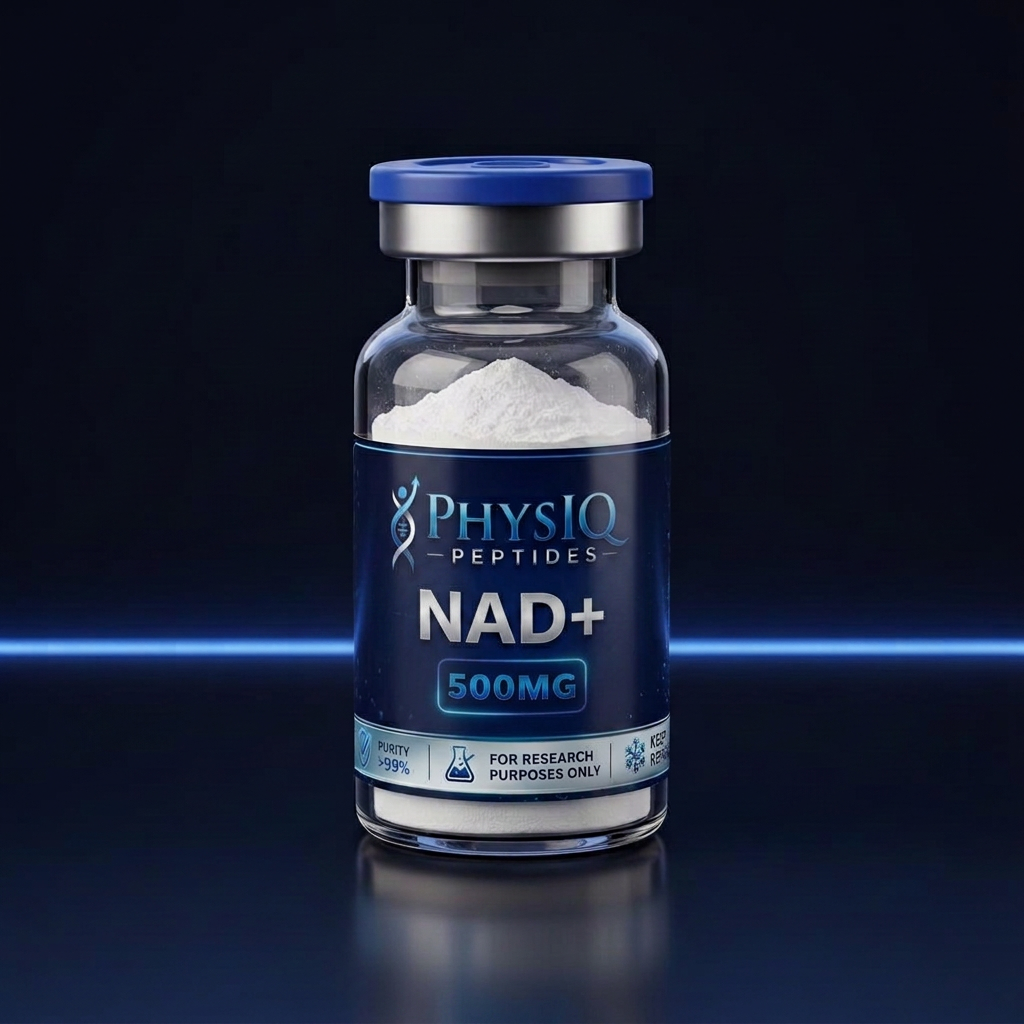
PhysIQ Peptides supplies NAD+ as a lyophilized powder, third-party tested for purity and identity, for in vitro and laboratory research use only.
Select size
Choose how to buy
You save $5.50 every reship · ≈ $66.92 saved per year
Auto-delivered • Skip or cancel anytime • Never run out
Your first order ships at the regular price. Every reship after that is 5% off. Pause, change the interval, or cancel anytime.
- Purity
- 99%
- Form
- Powder (lyophilized)
- CAS Number
- 53-84-9
- Molecular Formula
- C21H27N7O14P2
- Molecular Weight
- 663.43 g/mol
- Available sizes
- 500mg, 1,000mg
Also available in blends
Mechanism of Action
NAD+ functions both as a redox cofactor and as a consumable substrate. As a cofactor, it accepts electrons to become NADH, which feeds the mitochondrial electron transport chain. As a substrate, it is cleaved by sirtuins, PARPs and CD38, releasing nicotinamide that is recycled back to NAD+ through the salvage pathway via the enzyme NAMPT.
Research Areas
- ●Cellular redox and energy metabolism
- ●Sirtuin and PARP enzyme biology
- ●NAD+ salvage pathway research
- ●Age-related NAD+ decline models
Selected References
- Rajman L, Chwalek K, Sinclair DA. Cell Metab. 2018;27(3):529-547.
- Covarrubias AJ, et al. Nat Rev Mol Cell Biol. 2021;22(2):119-141.
Related Products