PT-141
PT-141 (Bremelanotide)
PT-141, known by its generic name bremelanotide, is a synthetic cyclic heptapeptide derived from Melanotan II. It differs from Melanotan II by having a free carboxylic acid at the C-terminus instead of an amide. Like other compounds in this family, it is built around the His-Phe-Arg-Trp core sequence shared by the natural melanocortin hormones (α-MSH and ACTH), with a lactam bridge that locks the peptide into a stable ring.
PT-141 emerged from Melanotan II research at the University of Arizona and was later developed by Palatin Technologies. In the laboratory it is used as a tool for studying central melanocortin receptor signaling, particularly the MC4 receptor in the hypothalamus. It is the active ingredient in an FDA-approved prescription drug; this product is a research-grade material, not a drug product.
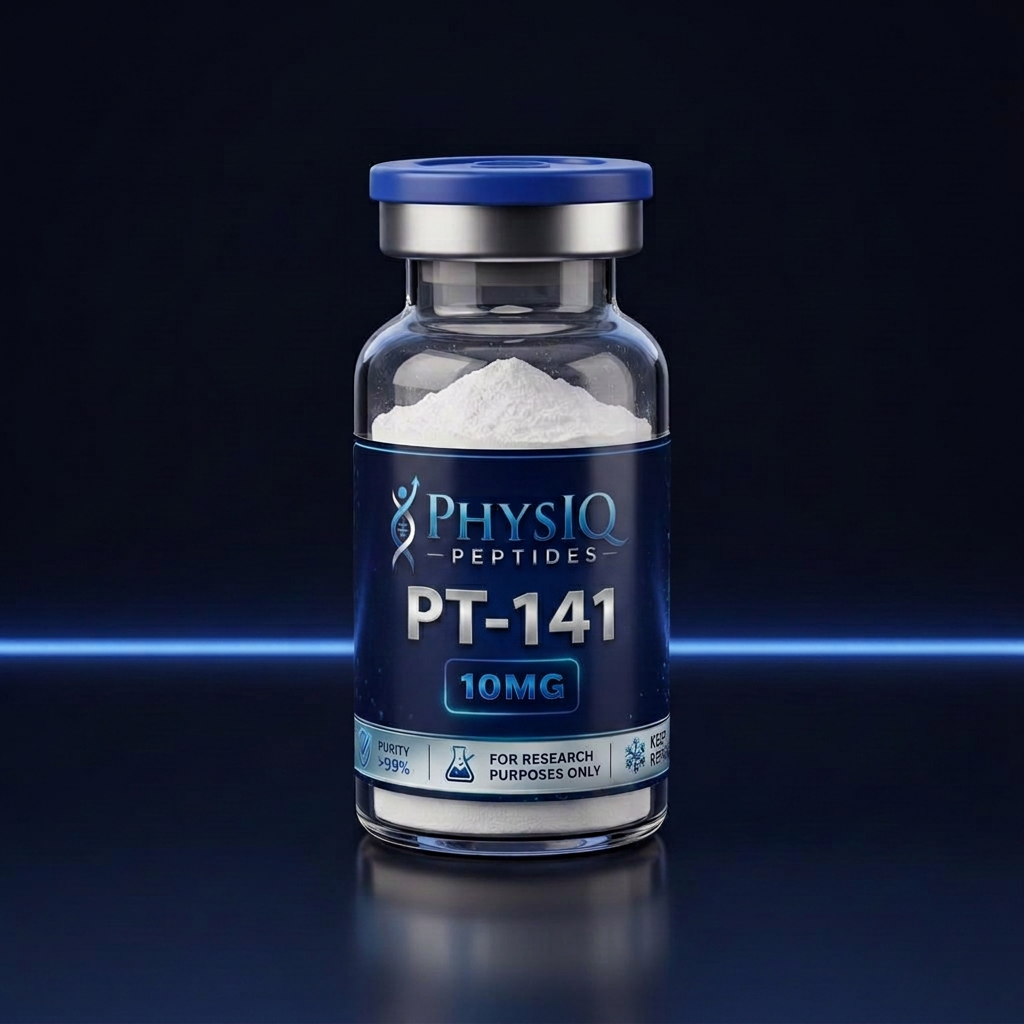
PhysIQ Peptides supplies PT-141 as a lyophilized powder, third-party tested for purity and identity, for in vitro and laboratory research use only.
Choose how to buy
You save $2.65 every reship · ≈ $32.24 saved per year
Auto-delivered • Skip or cancel anytime • Never run out
Your first order ships at the regular price. Every reship after that is 5% off. Pause, change the interval, or cancel anytime.
- Purity
- 99%
- Form
- Powder (lyophilized)
- CAS Number
- 189691-06-3
- Molecular Formula
- C50H68N14O10
- Molecular Weight
- 1025.2 g/mol
- Available sizes
- 10mg
Sequence
Ac-Nle-cyclo[Asp-His-D-Phe-Arg-Trp-Lys]-OH
Mechanism of Action
PT-141 is a non-selective melanocortin receptor agonist with its most studied activity at the MC3 and MC4 receptors in the central nervous system. These Gs-coupled receptors raise cAMP when activated. Compared with Melanotan II, PT-141 was characterized as having relatively less activity at the MC1 receptor, which governs pigmentation in melanocytes.
Research Areas
- ●MC3R / MC4R receptor pharmacology
- ●Central melanocortin signaling
- ●Hypothalamic neuropeptide research
- ●Cyclic peptide structure–activity studies
Selected References
- Hadley ME, Dorr RT. Peptides. 2006;27(4):921-930.
Related Products