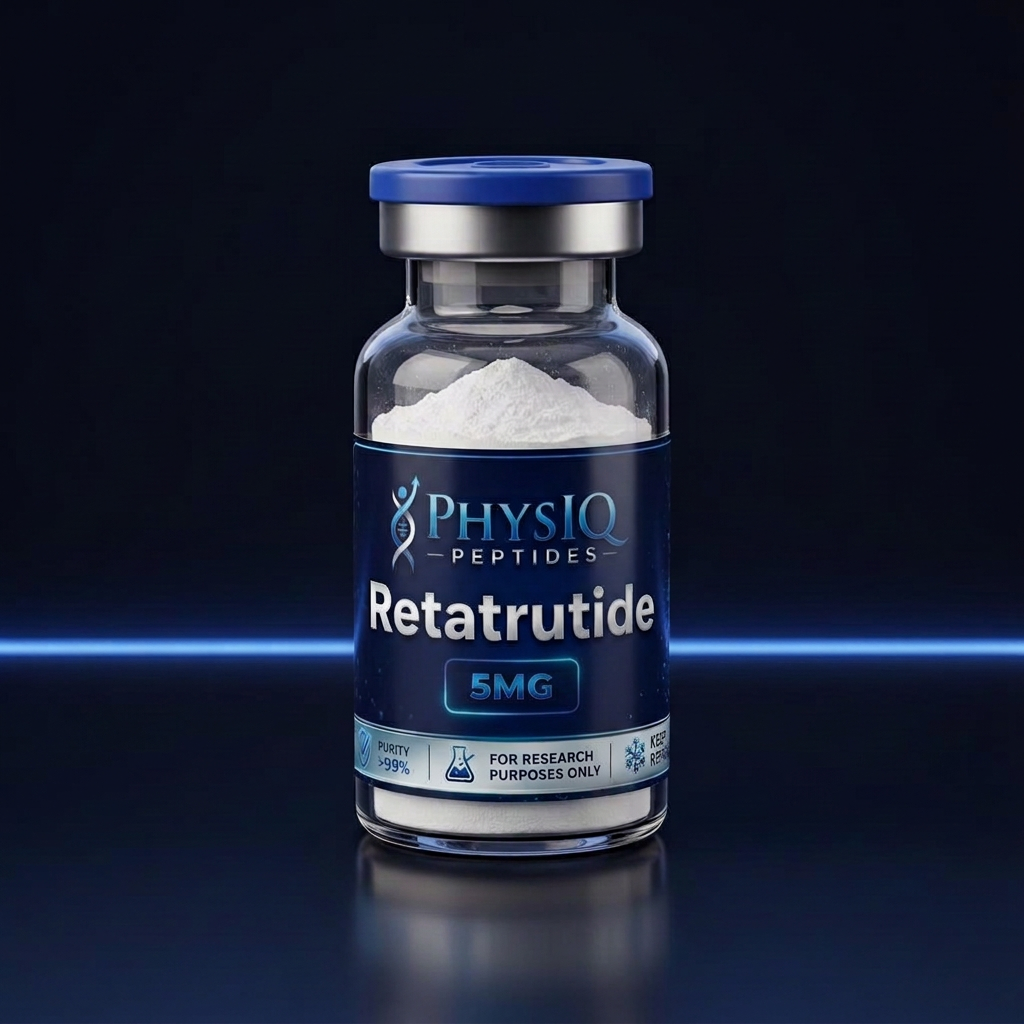
Retatrutide
Retatrutide (LY3437943)
Retatrutide, also known as Reta or LY3437943, is a synthetic 39-residue peptide engineered as a single molecule that activates three receptors in the incretin and glucagon family: the glucose-dependent insulinotropic polypeptide receptor (GIPR), the glucagon-like peptide-1 receptor (GLP-1R) and the glucagon receptor (GCGR). Its discovery and preclinical characterization were described by Coskun and colleagues in Cell Metabolism in 2022.
Structurally, retatrutide contains non-natural amino acids (Aib and α-methyl-leucine) that resist enzymatic degradation, and a lysine side chain acylated with a C20 fatty diacid through a γGlu-AEEA linker, a design that promotes albumin binding and an extended half-life in pharmacokinetic models. These features make it a reference compound for studying multi-receptor agonism and peptide half-life engineering.
Retatrutide is an investigational compound and is not approved by the FDA. PhysIQ Peptides supplies it as a lyophilized powder, third-party tested for purity and identity, for in vitro and laboratory research use only.
Select size
Choose how to buy
You save $2.75 every reship · ≈ $33.46 saved per year
Auto-delivered • Skip or cancel anytime • Never run out
Your first order ships at the regular price. Every reship after that is 5% off. Pause, change the interval, or cancel anytime.
- Purity
- 99%
- Form
- Powder (lyophilized)
- CAS Number
- 2381089-83-2
- Molecular Formula
- C221H342N46O68
- Molecular Weight
- 4731.33 g/mol
- Available sizes
- 5mg, 10mg, 20mg, 30mg
Sequence
Y-Aib-QGTFTSDYSI-αMeL-LDK-K(AEEA-γGlu-C20 diacid)-AQ-Aib-AFIEYLLEGGPSSGAPPPS-NH2
Mechanism of Action
In receptor-binding and cell-signaling assays, retatrutide acts as an agonist at GIPR, GLP-1R and GCGR, with its highest relative potency at the GIP receptor and lower relative potency at the GLP-1 and glucagon receptors compared with the native ligands. Activation of these Gs-coupled receptors raises intracellular cAMP. Preclinical studies use it to examine how simultaneous incretin and glucagon receptor signaling interacts, including effects on insulin secretion, hepatic glucose output and energy expenditure pathways in animal models.
Research Areas
- ●Incretin receptor pharmacology (GIPR, GLP-1R)
- ●Glucagon receptor signaling
- ●Multi-receptor agonist design
- ●Peptide acylation and half-life engineering
Selected References
- Coskun T, et al. Cell Metab. 2022;34(9):1234-1247.e9.
Related Products