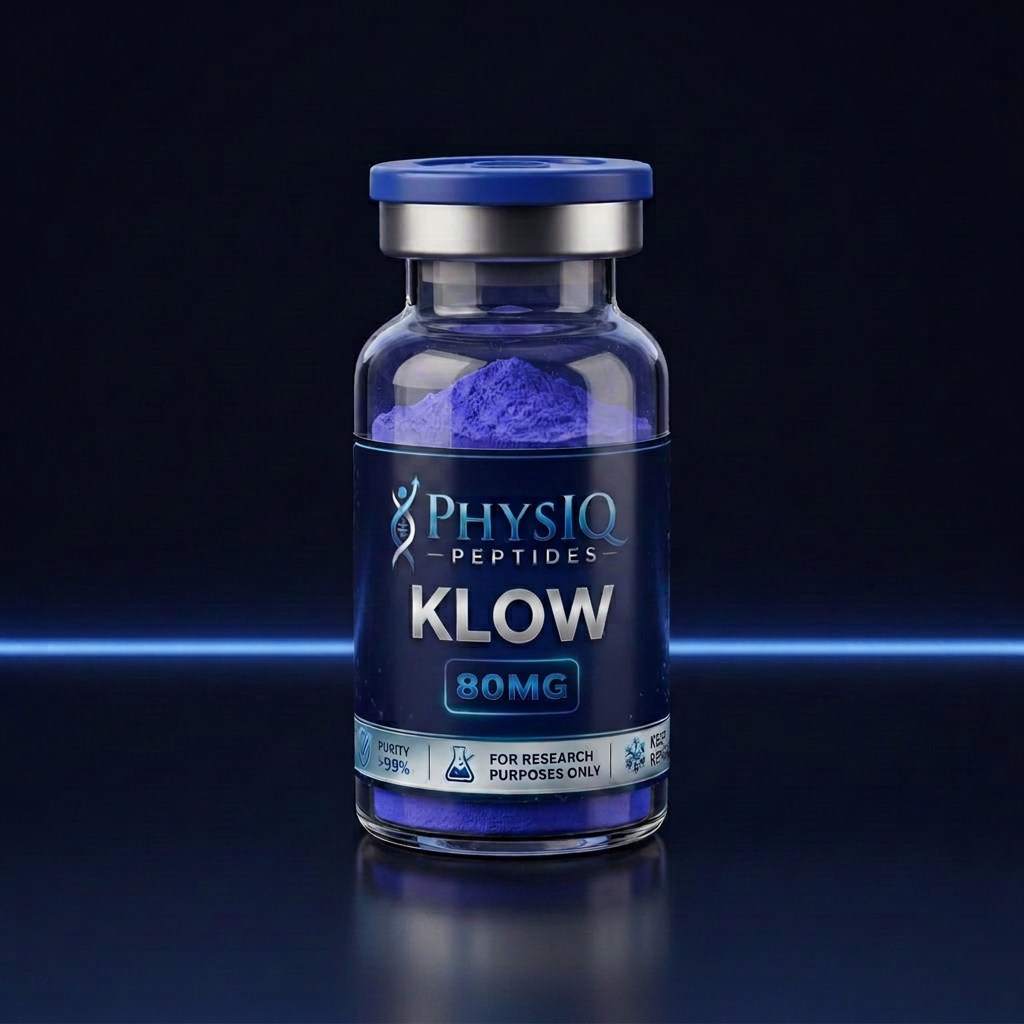
 Blend
KLOW
KLOW Blend (KPV / GHK-Cu / BPC-157 / TB-500)
KLOW extends the GLOW blend by adding KPV, combining four peptides in a single research vial: KPV, GHK-Cu, BPC-157 and TB-500. The addition of KPV brings an anti-inflammatory signaling component to a blend otherwise focused on matrix, vascular and cell-migration pathways.
KPV is the Lys-Pro-Val tripeptide from the C-terminus of α-MSH, studied for inhibiting NF-κB inflammatory signaling in intestinal and immune-cell models. GHK-Cu is the copper tripeptide studied in collagen and extracellular matrix research. BPC-157 is a stable gastric peptide studied in angiogenesis and repair models, and TB-500, based on thymosin beta-4, is studied for actin regulation and cell migration. The combination is designed for research into how inflammation resolution and tissue rebuilding interact.
PhysIQ Peptides supplies KLOW as a lyophilized powder, third-party tested for purity and identity, for in vitro and laboratory research use only.
Choose how to buy
You save $6.95 every reship · ≈ $84.56 saved per year
Auto-delivered • Skip or cancel anytime • Never run out
Your first order ships at the regular price. Every reship after that is 5% off. Pause, change the interval, or cancel anytime.
- Purity
- 99%
- Form
- Powder (lyophilized blend)
- Available sizes
- 80mg
Mechanism of Action
KPV enters cells via the PepT1 transporter and dampens NF-κB and MAP kinase inflammatory signaling. GHK-Cu supports collagen and extracellular matrix synthesis through copper delivery. BPC-157 modulates nitric oxide and growth factor receptor signaling, and TB-500 regulates actin dynamics and cell motility. KLOW is studied for the combined effects of these anti-inflammatory and repair pathways.
Research Areas
- ●Inflammation resolution and NF-κB signaling
- ●Extracellular matrix synthesis
- ●Angiogenesis and cell migration
- ●Combination peptide studies
Selected References
- Dalmasso G, et al. Gastroenterology. 2008;134(1):166-178.
- Pickart L, Margolina A. Int J Mol Sci. 2018;19(7):1987.
- Goldstein AL, Hannappel E, Kleinman HK. Trends Mol Med. 2005;11(9):421-429.