 Blend
BlendTesamorelin / Ipamorelin
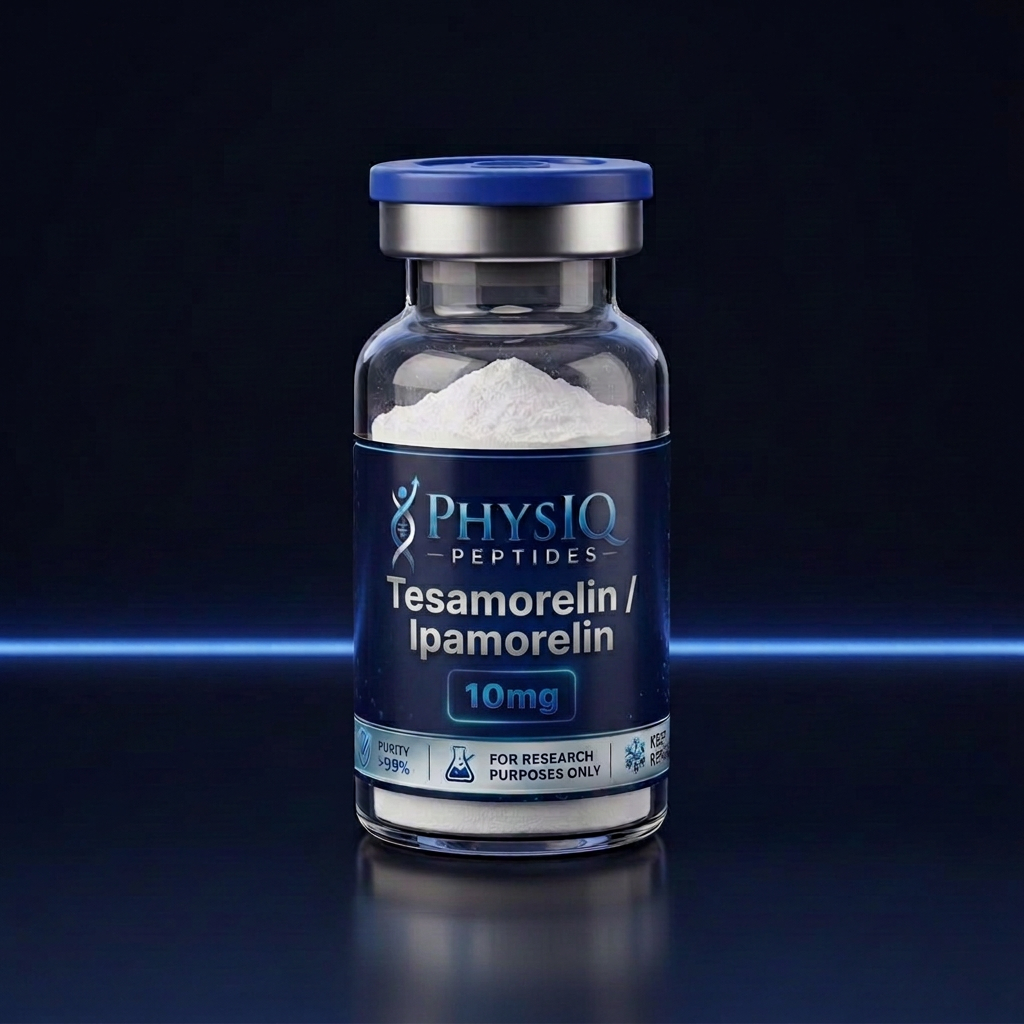
Tesamorelin / Ipamorelin Blend (10mg)
Tesamorelin / Ipamorelin is a composite research peptide formulation designed to evaluate the physiological synergy between a stabilized growth hormone-releasing hormone (GHRH) analogue and a selective growth hormone secretagogue receptor (GHSR-1a) agonist. Tesamorelin is a synthetic peptide consisting of the 44-amino-acid sequence of human GHRH modified with a trans-3-hexenoic acid moiety, engineered to resist enzymatic degradation. In tandem, Ipamorelin is a pentapeptide mimic of ghrelin that exhibits high receptor selectivity without inducing significant non-target neuroendocrine perturbations. In experimental models, the co-administration of these distinct secretagogues allows researchers to study the simultaneous amplification of endogenous, pulsatile somatotroph signaling. This dual-pathway approach provides an advanced biochemical framework for examining endocrine axis modulation, downstream insulin-like growth factor 1 (IGF-1) translation, and regulatory feedback loops in vitro and in vivo.
Choose how to buy
Subscribe & save 5% on reshipsYour first order ships at the regular price. Every reship after that is 5% off. Pause, change the interval, or cancel anytime.
- Purity
- ≥99%
- Form
- Lyophilized powder
- Available sizes
- 10mg
Mechanism of Action
The mechanism of action for this blend relies on the activation of two independent but convergent intracellular pathways within anterior pituitary somatotrophs. Tesamorelin binds specifically to the GHRH receptor (GHRH-R), a G-protein-coupled receptor that activates adenylyl cyclase, raising intracellular cyclic adenosine monophosphate (cAMP) and activating protein kinase A (PKA). This cascade promotes the transcription of growth hormone genes and triggers vesicular fusion for pulsatile GH release. Simultaneously, Ipamorelin selectively targets the growth hormone secretagogue receptor 1a (GHSR-1a), acting via the phospholipase C (PLC) and inositol trisphosphate (IP3) signaling cascade to mobilize intracellular calcium stores and suppress somatostatin tone. Working together, these mechanisms produce an amplified, physiologically regulated secretion of growth hormone without elevating adrenocorticotropic hormone (ACTH), cortisol, or prolactin levels in research models.
Research Areas
- ●Somatotrophic axis signaling and GH pulsatility
- ●Visceral adiposity and metabolic regulation models
- ●Cellular repair and tissue regeneration mechanisms
- ●Neurological and cardiovascular somatotropic interactions
- ●Comparative pharmacodynamics of multi-pathway secretagogues
Selected References
- Falutz J, et al. N Engl J Med. 2007;357(23):2359-2370.
- Raun K, et al. Eur J Endocrinol. 1998;139(5):552-561.
- Stanley TL, et al. JAMA. 2014;312(4):380-389.
- Svensson J, et al. Endocrinology. 2000;141(3):920-926.
Related Products