 Blend
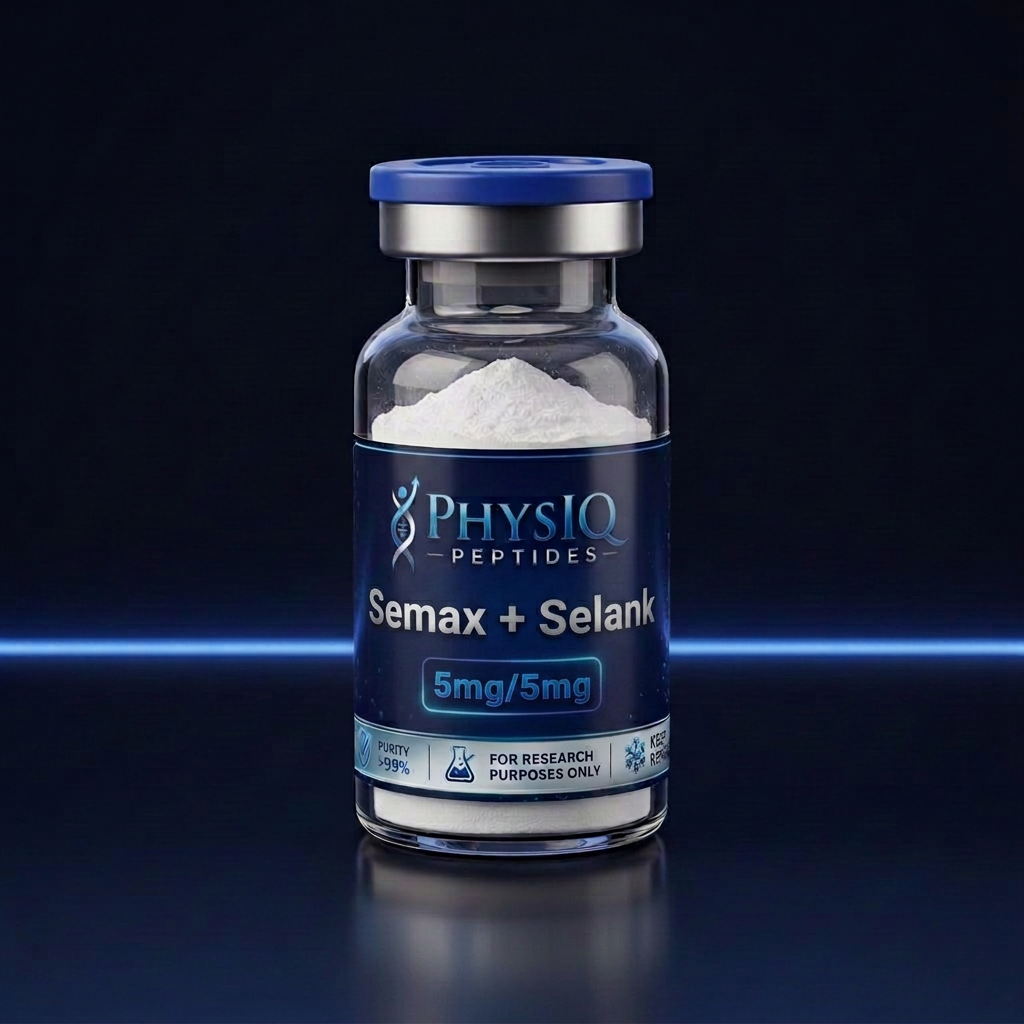
BlendSemax + Selank
Semax / Selank Synthetic Peptide Blend (5mg / 5mg)
Semax and Selank are synthetic heptapeptides originally developed by the Institute of Molecular Genetics of the Russian Academy of Sciences. Semax is an analog of the adrenocorticotropic hormone fragment ACTH(4-10) stabilized with a Pro-Gly-Pro tripeptide at the C-terminus. Selank is a structural analog of the endogenous immunomodulating peptide tuftsin (Thr-Lys-Pro-Arg), also extended with a C-terminal Pro-Gly-Pro sequence to enhance enzymatic stability and biological half-life. In laboratory research models, combining Semax and Selank allows investigators to assess dual-action neuroregulation. While Semax is predominantly studied for its stimulatory, neuroprotective, and cognitive-enhancing pathways, Selank is researched for its anxiolytic-like effects and modulation of emotional reactivity without classic sedative properties. Together, the blend provides a comprehensive platform for examining neurotrophic factor stimulation, neurotransmitter turnover, and stress-response pathways.
Select size
Choose how to buy
Subscribe & save 5% on reshipsYour first order ships at the regular price. Every reship after that is 5% off. Pause, change the interval, or cancel anytime.
- Purity
- ≥99%
- Form
- Lyophilized powder
- Available sizes
- 5mg/5mg, 10mg/10mg
Sequence
Semax: Met-Glu-His-Phe-Pro-Gly-Pro | Selank: Thr-Lys-Pro-Arg-Pro-Gly-Pro
Mechanism of Action
Semax functions primarily by upregulating the expression and synthesis of Brain-Derived Neurotrophic Factor (BDNF) and its receptor TrkB in the hippocampus and cortex. It also influences dopaminergic and serotonergic systems, modulates vascular endothelial growth factor (VEGF) expression, and suppresses pro-inflammatory cytokine activity in neural tissue. Selank modulates GABAergic neurotransmission by interacting with allosteric sites on GABA-A receptors and regulates the expression of genes involved in neurotransmission. Additionally, it inhibits the enzymatic degradation of endogenous enkephalins and balances monoamine neurotransmitter metabolism, contributing to its observed anxiolytic and immune-modulatory characteristics in test systems.
Research Areas
- ●Cognitive processing and memory consolidation
- ●Neuroprotection and ischemic injury models
- ●Neurotrophin regulation (BDNF and TrkB)
- ●GABAergic and monoaminergic neurotransmission
- ●Neuroimmune signaling and stress response modulation
Selected References
- Dolotov OV et al., J Neurochem, 2006
- Semenova TP et al., Bull Exp Biol Med, 2010
- Kost NV et al., Bioorg Khim, 2001
- Medvedeva EV et al., BMC Genomics, 2014
Related Products