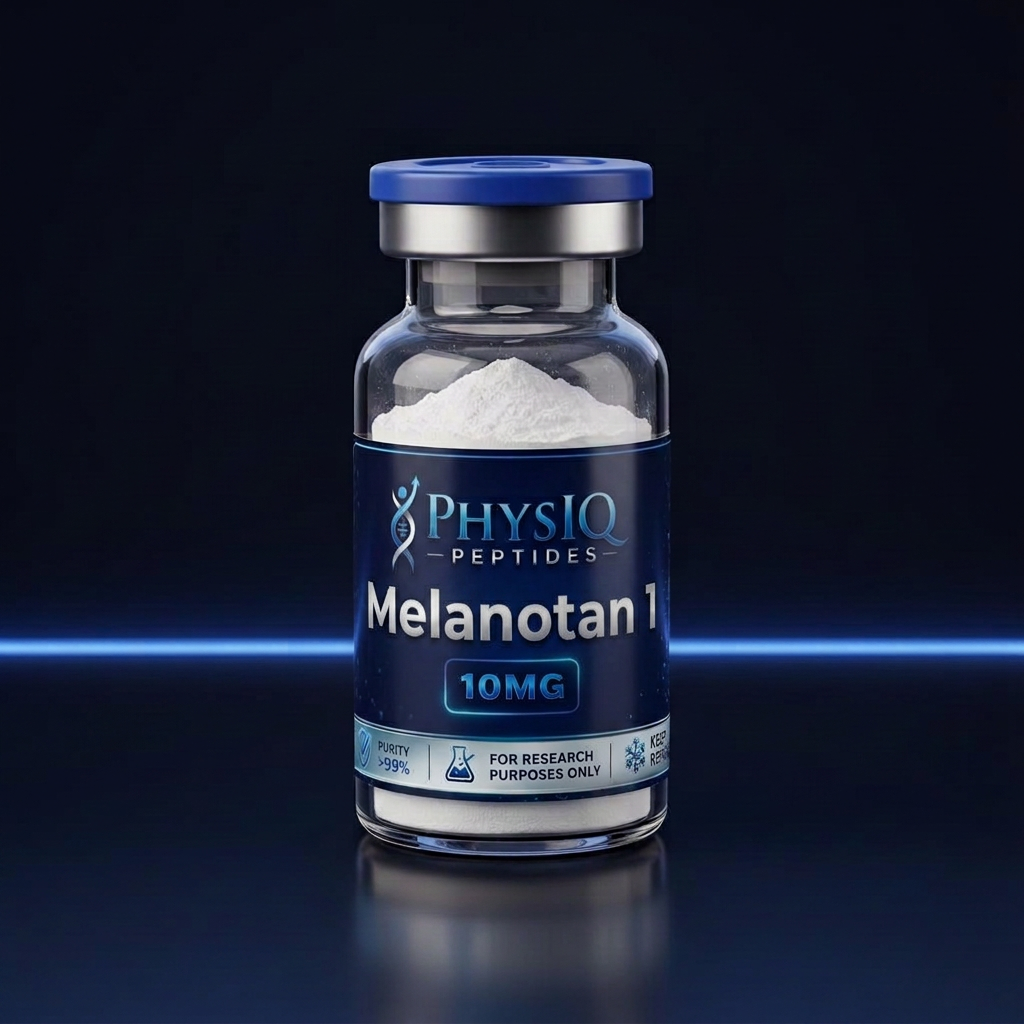
Melanotan 1
Melanotan 1 (Afamelanotide, [Nle4, D-Phe7]-α-MSH)
Melanotan 1, also known as afamelanotide or [Nle4, D-Phe7]-α-MSH, is a 13-amino-acid linear analog of α-melanocyte-stimulating hormone (α-MSH). It was developed at the University of Arizona in the 1980s by substituting two residues of the native hormone: norleucine for methionine at position 4, which prevents oxidation, and D-phenylalanine for L-phenylalanine at position 7, which increases potency and resistance to enzymatic breakdown.
These two changes made Melanotan 1 far more stable and longer-acting than α-MSH in research models, and it became a standard tool for studying the melanocortin 1 receptor (MC1R) on melanocytes and the pathways that regulate eumelanin production. Afamelanotide is the active ingredient in an approved prescription drug; this product is a research-grade material, not a drug product.
PhysIQ Peptides supplies Melanotan 1 as a lyophilized powder, third-party tested for purity and identity, for in vitro and laboratory research use only.
Choose how to buy
You save $1.80 every reship · ≈ $21.90 saved per year
Auto-delivered • Skip or cancel anytime • Never run out
Your first order ships at the regular price. Every reship after that is 5% off. Pause, change the interval, or cancel anytime.
- Purity
- 99%
- Form
- Powder (lyophilized)
- CAS Number
- 75921-69-6
- Molecular Formula
- C78H111N21O19
- Molecular Weight
- 1646.9 g/mol
- Available sizes
- 10mg
Sequence
Ac-Ser-Tyr-Ser-Nle-Glu-His-D-Phe-Arg-Trp-Gly-Lys-Pro-Val-NH2
Mechanism of Action
Melanotan 1 is a potent agonist of the melanocortin 1 receptor (MC1R), a Gs-coupled receptor on melanocytes. MC1R activation raises cAMP and upregulates tyrosinase and related enzymes that drive synthesis of eumelanin, the brown-black pigment, in cell and animal models. As a linear peptide it is more selective for MC1R than the cyclic analog Melanotan 2.
Research Areas
- ●MC1R receptor pharmacology
- ●Melanogenesis and tyrosinase pathway models
- ●α-MSH analog structure–activity studies
- ●Melanocyte biology
Selected References
- Hadley ME, Dorr RT. Peptides. 2006;27(4):921-930.
Related Products