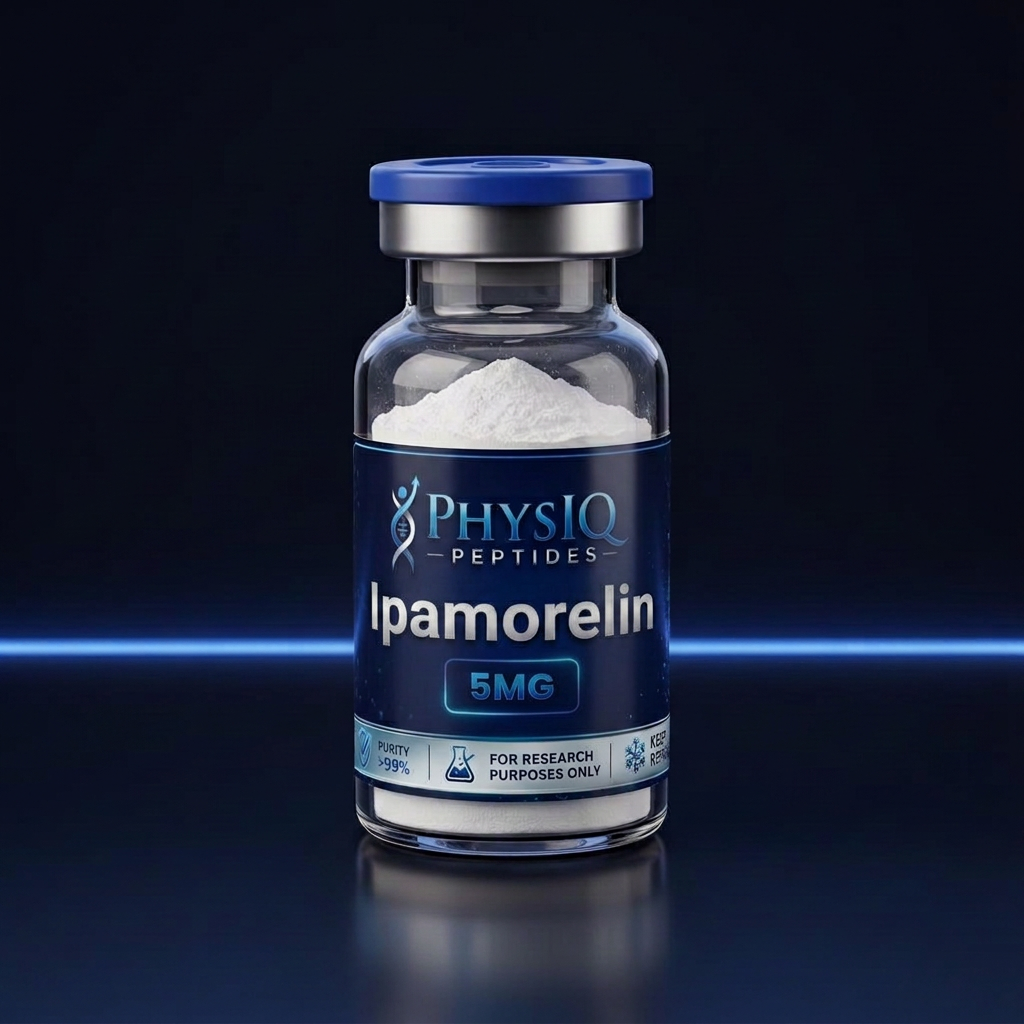
Ipamorelin
Ipamorelin (NNC 26-0161)
Ipamorelin is a synthetic pentapeptide growth hormone secretagogue developed by Novo Nordisk in the 1990s. It belongs to the growth hormone-releasing peptide (GHRP) family but was designed for selectivity: in the original characterization by Raun and colleagues (European Journal of Endocrinology, 1998), it released growth hormone in animal models without the accompanying rises in ACTH and cortisol seen with earlier GHRPs such as GHRP-6 and GHRP-2.
That selectivity makes ipamorelin a useful tool compound for isolating ghrelin-receptor–driven growth hormone release from other pituitary responses. It is also frequently paired with GHRH analogs in research on how the two pathways interact to shape GH pulses.
PhysIQ Peptides supplies ipamorelin as a lyophilized powder, third-party tested for purity and identity, for in vitro and laboratory research use only.
Choose how to buy
You save $1.75 every reship · ≈ $21.29 saved per year
Auto-delivered • Skip or cancel anytime • Never run out
Your first order ships at the regular price. Every reship after that is 5% off. Pause, change the interval, or cancel anytime.
- Purity
- 99%
- Form
- Powder (lyophilized)
- CAS Number
- 170851-70-4
- Molecular Formula
- C38H49N9O5
- Molecular Weight
- 711.85 g/mol
- Available sizes
- 5mg
Sequence
Aib-His-D-2Nal-D-Phe-Lys-NH2
Also available in blends
Mechanism of Action
Ipamorelin is an agonist of the growth hormone secretagogue receptor type 1a (GHS-R1a), the receptor for the endogenous hormone ghrelin. Activation of GHS-R1a on pituitary somatotrophs triggers Gq-mediated calcium signaling and growth hormone release. Unlike many GHRPs, ipamorelin shows little effect on ACTH, cortisol or prolactin in published animal studies, which is the basis of its description as a selective secretagogue.
Research Areas
- ●Ghrelin receptor (GHS-R1a) pharmacology
- ●Growth hormone pulsatility models
- ●GHRP selectivity studies
- ●GHRH and GHRP pathway interaction
Selected References
- Raun K, et al. Eur J Endocrinol. 1998;139(5):552-561.
Related Products