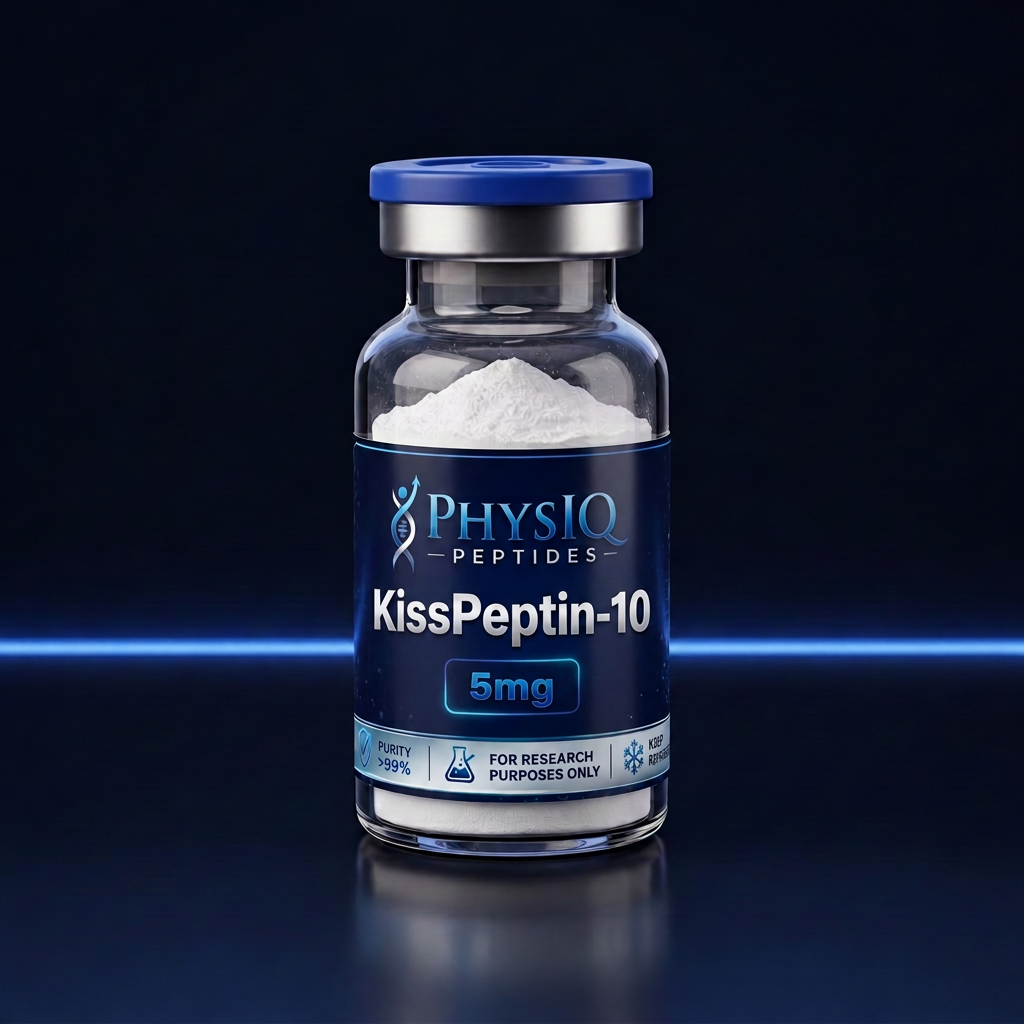
KissPeptin-10
Kisspeptin-10 (Metastin 45-54, human)
Kisspeptin-10 is the shortest biologically active form of kisspeptin, a family of peptides encoded by the KISS1 gene. The gene was originally identified in 1996 as a metastasis suppressor in melanoma cells, which is why the 54-residue peptide is also called metastin. Kisspeptin-10 corresponds to the C-terminal ten amino acids (residues 45-54), which carry the RF-amide motif needed for receptor activation.
In 2001, Kotani and colleagues identified kisspeptins as the natural ligands of the orphan receptor GPR54, now called KISS1R. Shortly after, mutations in this receptor were linked to failures of puberty, establishing kisspeptin signaling as a central regulator of the reproductive axis. Kisspeptin-10 is widely used as a tool compound in research on gonadotropin-releasing hormone (GnRH) neurons and reproductive endocrinology.
PhysIQ Peptides supplies Kisspeptin-10 as a lyophilized powder, third-party tested for purity and identity, for in vitro and laboratory research use only.
Select size
Choose how to buy
You save $1.85 every reship · ≈ $22.51 saved per year
Auto-delivered • Skip or cancel anytime • Never run out
Your first order ships at the regular price. Every reship after that is 5% off. Pause, change the interval, or cancel anytime.
- Purity
- 99%
- Form
- Powder (lyophilized)
- CAS Number
- 374675-21-5
- Molecular Formula
- C63H83N17O14
- Molecular Weight
- 1302.44 g/mol
- Available sizes
- 5mg, 10mg
Sequence
Tyr-Asn-Trp-Asn-Ser-Phe-Gly-Leu-Arg-Phe-NH2 (YNWNSFGLRF-NH2)
Mechanism of Action
Kisspeptin-10 is a full agonist of KISS1R (GPR54), a Gq-coupled receptor expressed on hypothalamic GnRH neurons. Receptor activation triggers phospholipase C signaling and intracellular calcium release, depolarizing GnRH neurons and driving GnRH secretion, which in turn stimulates pituitary LH and FSH release in research models.
Research Areas
- ●KISS1R (GPR54) receptor pharmacology
- ●GnRH neuron and HPG-axis research
- ●Puberty onset models
- ●Metastasis-suppressor biology
Selected References
- Kotani M, et al. J Biol Chem. 2001;276(37):34631-34636.
Related Products