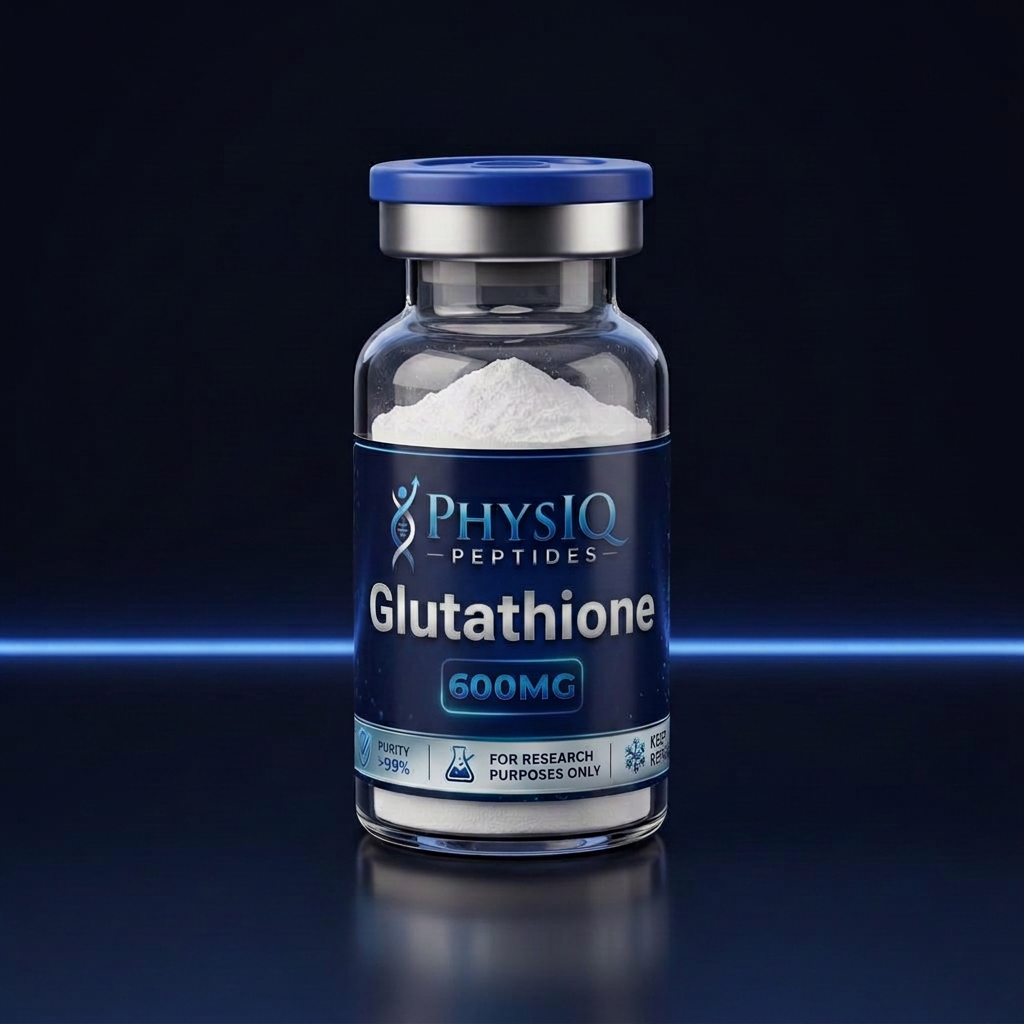
Glutathione
L-Glutathione, reduced (GSH)
Glutathione is a tripeptide made of glutamate, cysteine and glycine, with an unusual linkage: the glutamate is attached through its side-chain (gamma) carboxyl group rather than the usual backbone bond. This gamma linkage protects glutathione from breakdown by most peptidases. It is present at millimolar concentrations inside most cells, making it the most abundant low-molecular-weight thiol in animal tissues.
The reactive thiol group on its cysteine allows glutathione to donate electrons, neutralizing reactive oxygen species and becoming oxidized to glutathione disulfide (GSSG) in the process. The ratio of reduced to oxidized glutathione is widely used in research as an indicator of cellular redox state. A 2009 review by Forman, Zhang and Rinna in Molecular Aspects of Medicine describes its synthesis, functions and role in cell signaling.
PhysIQ Peptides supplies reduced glutathione as a powder, third-party tested for purity and identity, for in vitro and laboratory research use only.
Select size
Choose how to buy
You save $2.40 every reship · ≈ $29.20 saved per year
Auto-delivered • Skip or cancel anytime • Never run out
Your first order ships at the regular price. Every reship after that is 5% off. Pause, change the interval, or cancel anytime.
- Purity
- 99%
- Form
- Powder (lyophilized)
- CAS Number
- 70-18-8
- Molecular Formula
- C10H17N3O6S
- Molecular Weight
- 307.32 g/mol
- Available sizes
- 600mg, 1,500mg
Sequence
γ-Glu-Cys-Gly
Mechanism of Action
Glutathione acts as a cofactor for glutathione peroxidases, which reduce hydrogen peroxide and lipid peroxides, and for glutathione S-transferases, which conjugate it to electrophilic compounds for detoxification. Glutathione reductase recycles GSSG back to GSH using NADPH. It also regulates protein function through S-glutathionylation of cysteine residues.
Research Areas
- ●Cellular redox state (GSH/GSSG) research
- ●Oxidative stress models
- ●Detoxification and conjugation pathways
- ●Protein S-glutathionylation
Selected References
- Forman HJ, Zhang H, Rinna A. Mol Aspects Med. 2009;30(1-2):1-12.
Related Products