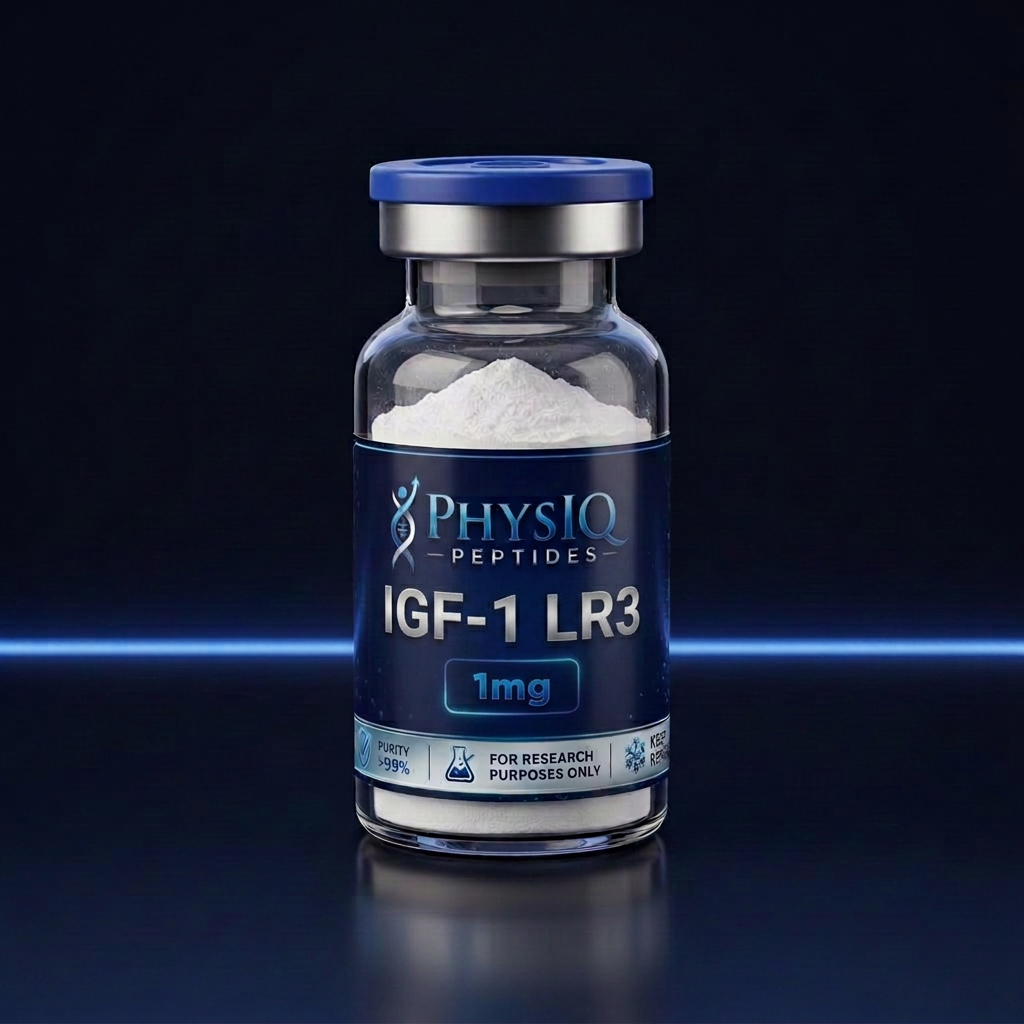
IGF-1 LR3
Long Arg3 Insulin-Like Growth Factor-1
IGF-1 LR3 (Long Arg3 Insulin-like Growth Factor-1) is an 83-amino-acid recombinant analog of human IGF-1. It is structurally modified with an N-terminal 13-amino-acid extension peptide and a glutamic acid-to-arginine substitution at position 3. These structural modifications drastically lower its affinity for insulin-like growth factor-binding proteins (IGFBPs), allowing higher concentrations of the peptide to remain free and biologically active in experimental models. Because endogenous IGFBPs typically sequester native IGF-1 and limit its receptor interaction, IGF-1 LR3 demonstrates a prolonged half-life and markedly enhanced biological potency in laboratory assays. This makes it an essential tool for evaluating IGF-1 receptor dynamics, autocrine and paracrine cellular communication, and downstream phosphorylation cascades without interference from binding proteins. In preclinical research environments, IGF-1 LR3 is extensively utilized to probe pathways governing cellular proliferation, differentiation, protein synthesis, and metabolic homeostasis in various cell cultures and non-human tissue models. All products are intended solely for laboratory investigation and in vitro research.
Choose how to buy
Subscribe & save 5% on reshipsYour first order ships at the regular price. Every reship after that is 5% off. Pause, change the interval, or cancel anytime.
- Purity
- ≥99%
- Form
- Lyophilized powder
- CAS Number
- 949837-92-9
- Molecular Formula
- C400H625N111O115S9
- Molecular Weight
- 9117.5 g/mol
- Available sizes
- 1mg
Sequence
MFPAMPLSSLFVNGPRTLCGAELVDALQFVCGDRGFYFNKPTGYGSSSRRAPQTGIVDECCFRSCDLRRLEMYCAPLKPAKSA
Mechanism of Action
IGF-1 LR3 functions by selectively binding to the type 1 IGF receptor (IGF-1R), a receptor tyrosine kinase located on the cell membrane. Ligand binding induces autophosphorylation of the receptor's intracellular kinase domains, recruiting docking proteins such as insulin receptor substrate 1 (IRS-1). This triggers two primary signaling pathways: the PI3K/Akt pathway, which promotes cell survival, glucose uptake, and anabolic protein synthesis via mTOR activation, and the MAPK/ERK pathway, which drives mitogenesis and cellular proliferation. Unlike native IGF-1, the structural modifications of IGF-1 LR3 prevent sequestration by IGFBP-1 through IGFBP-6. Consequently, receptor binding and downstream kinase activation occur at significantly lower concentrations and persist over extended experimental timeframes, facilitating high-resolution study of sustained growth factor signaling.
Research Areas
- ●Cellular proliferation and mitogenic signaling
- ●mTOR and Akt pathway activation
- ●Myoblast differentiation and hypertrophy models
- ●Glucose transport and metabolic kinetics
- ●Tissue regeneration and cellular senescence
Selected References
- Tomas FM, et al. Biochem J. 1992;288(Pt 3):969-976.
- Ballard FJ, et al. J Endocrinol. 1996;149(3):417-427.
- Clemmons DR. Cytokine Growth Factor Rev. 2007;18(5-6):339-346.
Related Products