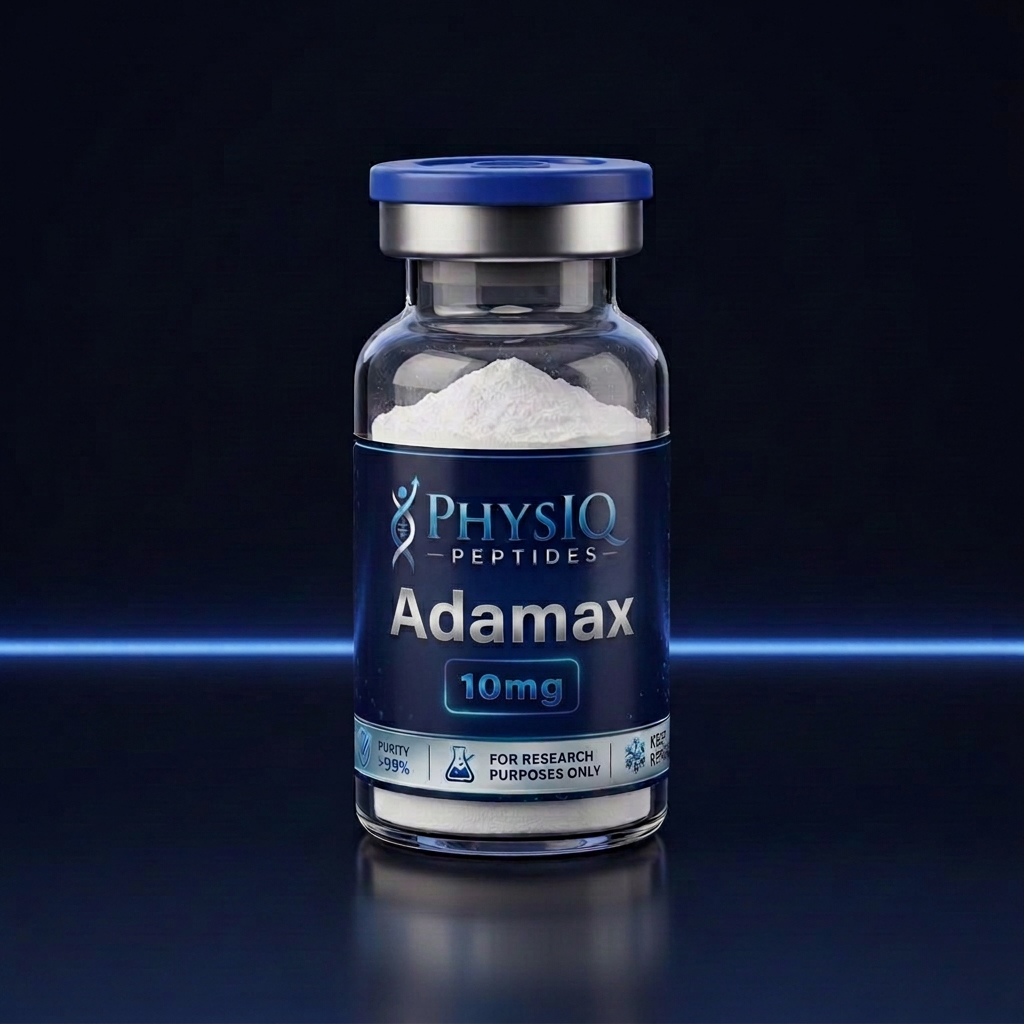
Adamax
N-Acetyl Semax Adamantyl Hybrid
Adamax is an innovative synthetic peptide derivative modeled after Semax, an analog of the ACTH (4-10) fragment. Structurally modified with an N-terminal acetyl group and a C-terminal adamantane moiety, Adamax was designed for experimental investigations requiring increased lipophilicity and resistance to enzymatic degradation in vitro and in vivo. In laboratory models, Adamax serves as a primary tool for studying central nervous system dynamics, specifically the modulation of neurotrophic factors such as brain-derived neurotrophic factor (BDNF) and nerve growth factor (NGF). The hydrophobic nature of the adamantyl functional group is of significant research interest regarding altered cellular permeability and receptor residence times compared to standard peptide analogs.
Choose how to buy
Subscribe & save 5% on reshipsYour first order ships at the regular price. Every reship after that is 5% off. Pause, change the interval, or cancel anytime.
- Purity
- ≥99%
- Form
- Lyophilized powder
- Available sizes
- 10mg
Sequence
Ac-Met-Glu-His-Phe-Pro-Gly-Pro-NH-Adamantane
Mechanism of Action
Adamax is hypothesized to exert its primary neurobiological effects via the upregulation of BDNF and its high-affinity receptor, TrkB. Experimental data indicates this activation cascades through intracellular signaling networks, including the MAPK/ERK and PI3K/Akt pathways, promoting neuronal resilience and dendritic arborization. Additionally, the molecular configuration of Adamax facilitates interaction with central melanocortin and dopaminergic signaling cascades, potentially modulating neurotransmitter turnover and mitigating neuroinflammatory markers in neurochemical research models.
Research Areas
- ●Neurotrophic factor regulation (BDNF/NGF)
- ●Synaptic plasticity and dendritic remodeling
- ●Neuroprotection under oxidative stress conditions
- ●Blood-brain barrier permeability kinetics
- ●Central neurotransmitter modulation
Selected References
- Dolotov OV et al. J Mol Neurosci. 2004.
- Gudasheva TA et al. Russ J Bioorg Chem. 2012.
- Scimonelli T et al. Neuropeptides. 2010.
Related Products