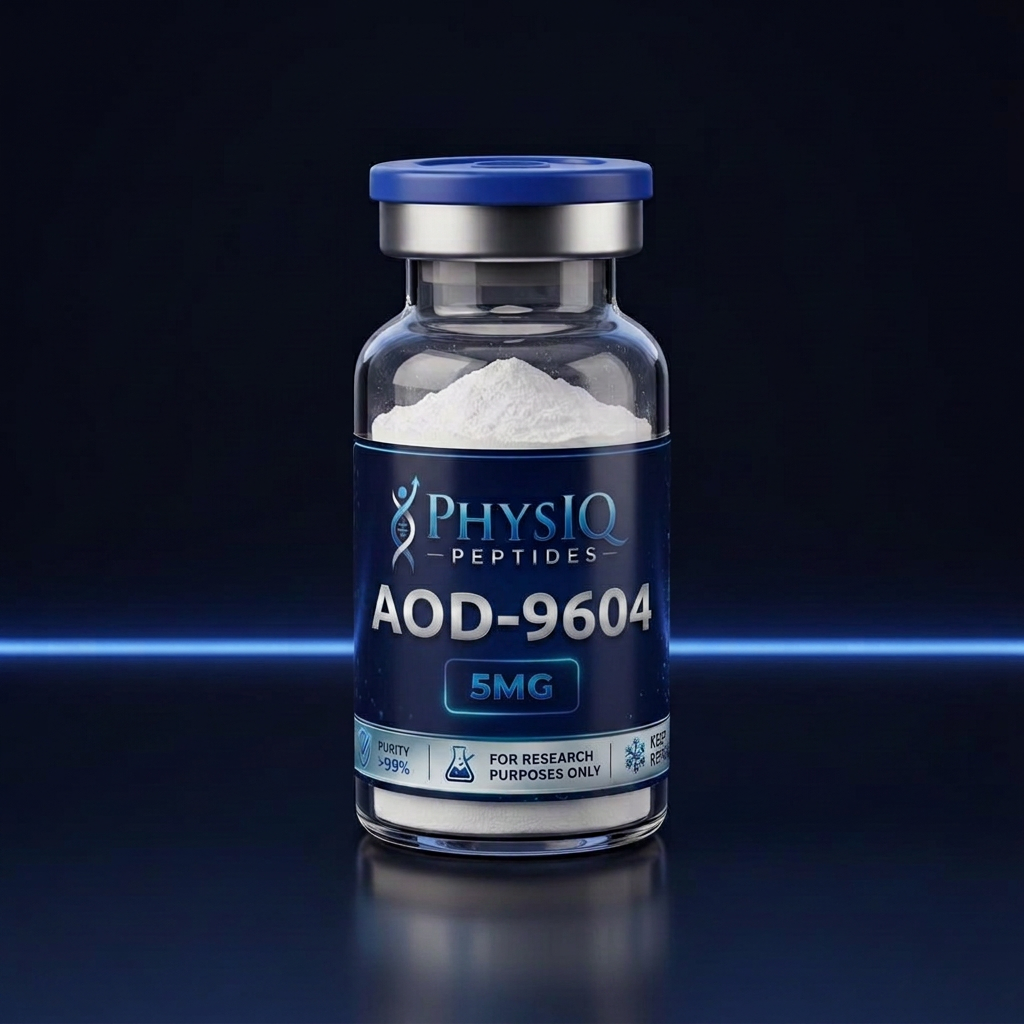
AOD-9604
AOD-9604 (Tyr-hGH 177-191)
AOD-9604 is a 16-amino-acid synthetic peptide based on the C-terminal region (residues 177-191) of human growth hormone, with an added tyrosine at the N-terminus. It was developed to isolate the lipid-metabolism activity associated with this region of hGH from growth hormone's other effects, such as on IGF-1 and cell growth. The peptide contains a single disulfide bridge between its two cysteines.
In a 2001 Endocrinology study, Heffernan and colleagues compared full-length hGH with AOD-9604 in obese mouse models and in adipose tissue, reporting effects on lipolysis and lipogenesis without the IGF-1 elevation produced by intact growth hormone. AOD-9604 remains a research tool for studying how specific domains of hGH relate to its metabolic actions.
PhysIQ Peptides supplies AOD-9604 as a lyophilized powder, third-party tested for purity and identity, for in vitro and laboratory research use only.
Choose how to buy
You save $2.25 every reship · ≈ $27.38 saved per year
Auto-delivered • Skip or cancel anytime • Never run out
Your first order ships at the regular price. Every reship after that is 5% off. Pause, change the interval, or cancel anytime.
- Purity
- ≥99%
- Form
- Powder (lyophilized)
- CAS Number
- 221231-10-3
- Molecular Formula
- C78H123N23O23S2
- Molecular Weight
- 1815.1 g/mol
- Available sizes
- 5mg
Sequence
YLRIVQCRSVEGSCGF (disulfide bridge Cys7–Cys14)
Mechanism of Action
AOD-9604 does not bind the growth hormone receptor in the same way as full-length hGH and does not stimulate IGF-1 production in published animal studies. Its reported activity in adipose tissue models involves stimulation of lipolysis and inhibition of lipogenesis, with some studies implicating β3-adrenergic receptor pathways. The precise receptor mechanism is not fully characterized.
Research Areas
- ●Adipocyte lipolysis and lipogenesis models
- ●hGH domain structure–function studies
- ●IGF-1-independent metabolic signaling
- ●Disulfide-bridged peptide stability
Selected References
- Heffernan M, et al. Endocrinology. 2001;142(12):5182-5189.
Related Products