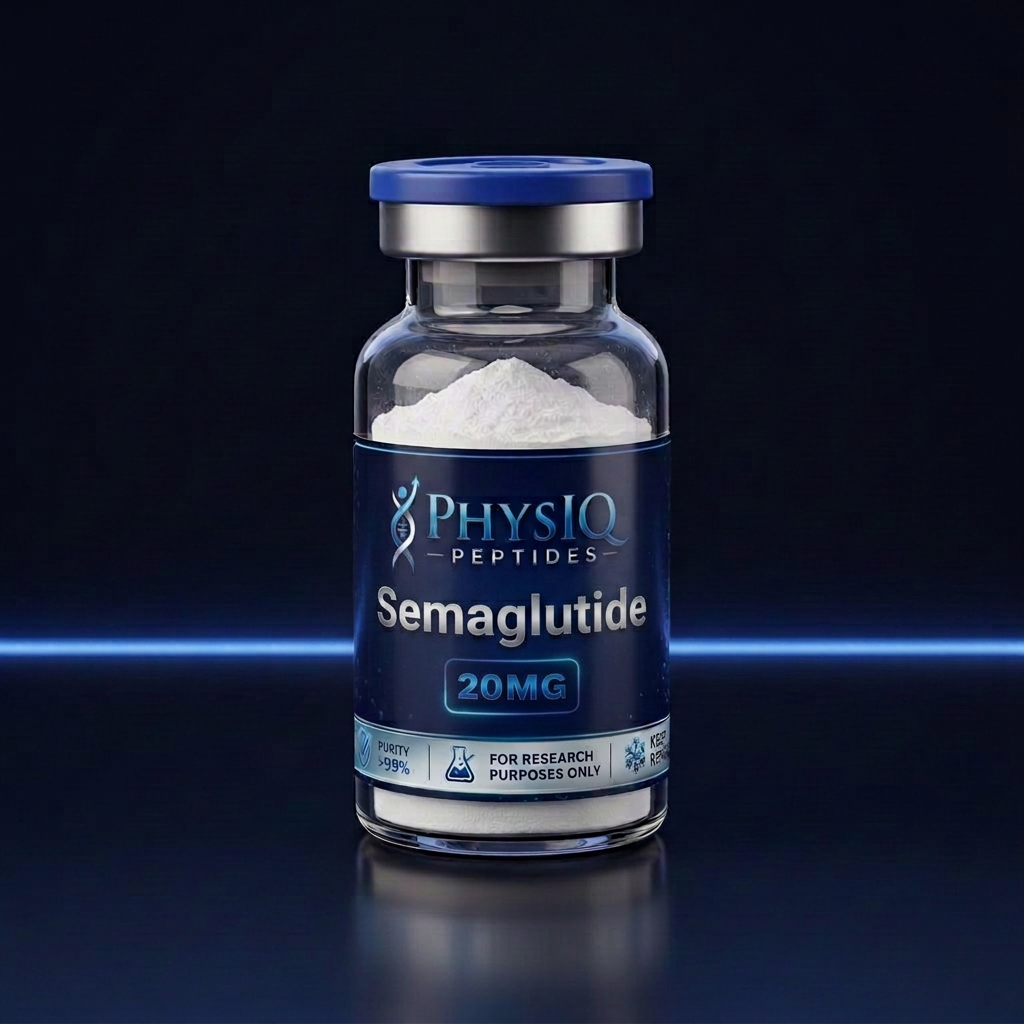
Semaglutide
Semaglutide
Semaglutide is a 31-amino-acid analog of human glucagon-like peptide-1 (GLP-1) with about 94% sequence homology to the native hormone. Two structural changes distinguish it: an α-aminoisobutyric acid (Aib) at position 8, which protects against cleavage by the enzyme DPP-4, and a lysine side chain at position 26 acylated with a C18 fatty diacid through a γGlu-OEG-OEG linker, which promotes reversible albumin binding. Together these extend its half-life to roughly a week in pharmacokinetic studies, compared with minutes for native GLP-1.
The design and structure–activity work behind semaglutide was published by Lau and colleagues in the Journal of Medicinal Chemistry in 2015, and it has since become a benchmark molecule for studying GLP-1 receptor pharmacology and fatty-acid acylation as a half-life strategy.
Semaglutide is the active ingredient in FDA-approved prescription drugs; this product is a research-grade material, not a drug product. PhysIQ Peptides supplies it as a lyophilized powder, third-party tested for purity and identity, for in vitro and laboratory research use only.
Select size
Choose how to buy
You save $7.00 every reship · ≈ $85.17 saved per year
Auto-delivered • Skip or cancel anytime • Never run out
Your first order ships at the regular price. Every reship after that is 5% off. Pause, change the interval, or cancel anytime.
- Purity
- 99%
- Form
- Powder (lyophilized)
- CAS Number
- 910463-68-2
- Molecular Formula
- C187H291N45O59
- Molecular Weight
- 4113.58 g/mol
- Available sizes
- 20mg, 30mg
Sequence
H-Aib-EGTFTSDVSSYLEGQAAK(γGlu-2xOEG-C18 diacid)EFIAWLVRGRG-OH
Mechanism of Action
Semaglutide is a selective agonist of the GLP-1 receptor, a class B G protein-coupled receptor. Receptor activation stimulates adenylyl cyclase and raises intracellular cAMP, which in pancreatic beta-cell models potentiates glucose-dependent insulin secretion. Its albumin binding and DPP-4 resistance give it a prolonged exposure profile, which is why it is frequently used in studies comparing short- and long-acting incretin analogs.
Research Areas
- ●GLP-1 receptor pharmacology
- ●Incretin signaling and beta-cell models
- ●Peptide acylation and albumin binding
- ●DPP-4 resistance and half-life engineering
Selected References
- Lau J, et al. J Med Chem. 2015;58(18):7370-7380.
Related Products