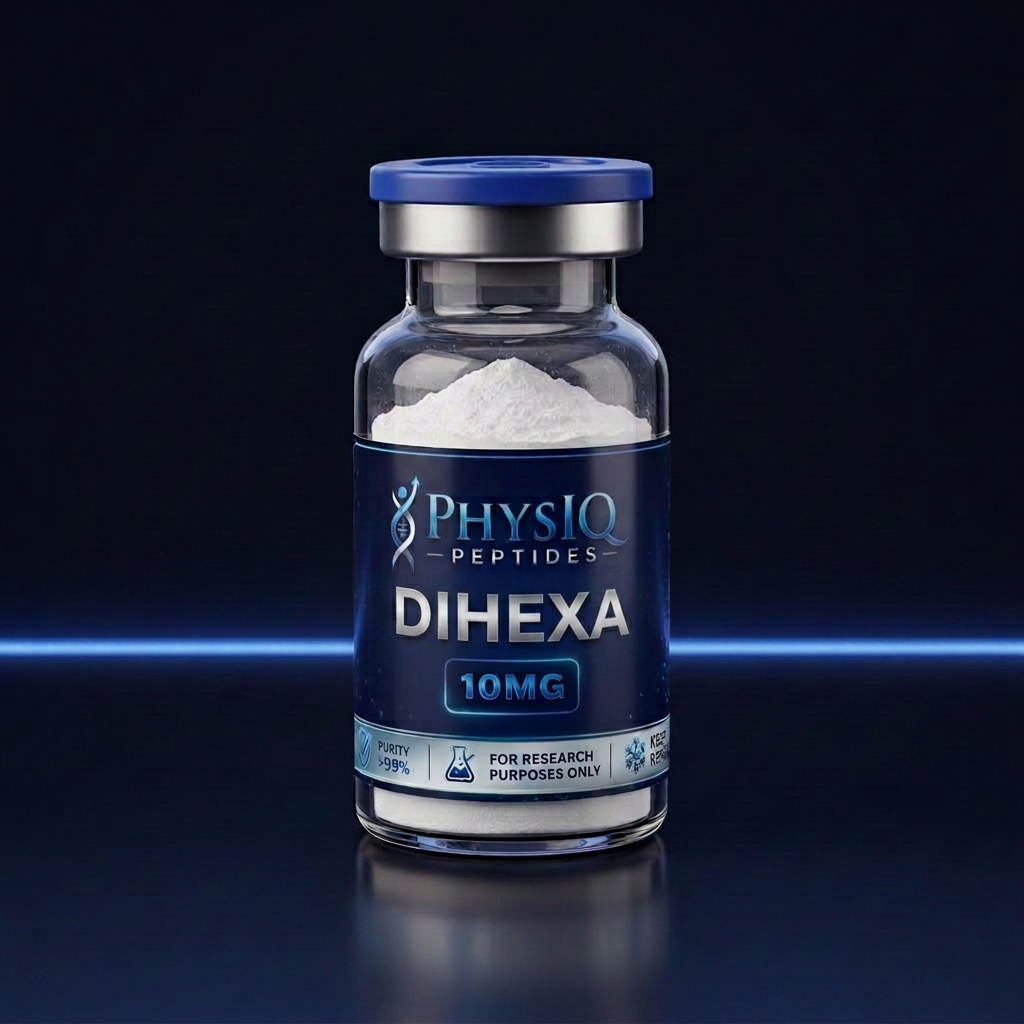
Dihexa
Dihexa (N-hexanoic-Tyr-Ile-(6) aminohexanoic amide)
Dihexa is a synthetic, oligopeptide-derived small molecule designed as a stable analog of angiotensin IV (AngIV). Developed primarily to overcome the rapid metabolic degradation and poor blood-brain barrier permeability of native AngIV, Dihexa serves as an essential tool compound in neurodegenerative and cognitive research models. In preclinical assays, Dihexa has demonstrated remarkable efficacy in promoting dendritic spine formation and enhancing synaptic connectivity. In cellular and rodent systems, the compound exhibits potent neurogenic activity, frequently investigated for its comparative efficacy against standard endogenous neurotrophic factors.
Choose how to buy
Subscribe & save 5% on reshipsYour first order ships at the regular price. Every reship after that is 5% off. Pause, change the interval, or cancel anytime.
- Purity
- ≥99%
- Form
- Lyophilized powder
- CAS Number
- 1401708-83-5
- Molecular Formula
- C27H44N4O5
- Molecular Weight
- 504.67 g/mol
- Available sizes
- 10mg
Sequence
N-hexanoyl-Tyr-Ile-Ahx-NH2
Mechanism of Action
Dihexa acts as a high-affinity ligand for hepatocyte growth factor (HGF), facilitating its dimerization and subsequent activation of the c-Met receptor tyrosine kinase signaling cascade. This activation stimulates downstream pathways, notably MAPK/ERK and PI3K/Akt, which are critical for cytoskeletal reorganization, dendritic arborization, and synaptic plasticity.
Research Areas
- ●Synaptogenesis and dendritic spine morphogenesis
- ●Neurodegenerative disease models
- ●HGF/c-Met signaling pathway dynamics
- ●Cognitive enhancement and memory consolidation models
- ●Neuronal repair and plasticity mechanisms
Selected References
- Benoist CC, et al. J Pharmacol Exp Ther. 2014.
- McCoy AT, et al. J Pharmacol Exp Ther. 2013.
- Wright JW, Harding JW. Prog Neurobiol. 2015.
Related Products