Epithalon
Epithalon (Epitalon, AEDG)
Epithalon (also spelled Epitalon) is a synthetic tetrapeptide, Ala-Glu-Asp-Gly, developed by Vladimir Khavinson and colleagues at the St. Petersburg Institute of Bioregulation and Gerontology. It was designed as a defined synthetic counterpart to epithalamin, a polypeptide extract of the bovine pineal gland studied in Russian gerontology research from the 1980s onward.
Epithalon is best known in the literature for cell-culture work on telomerase. In a 2003 Bulletin of Experimental Biology and Medicine report, Khavinson's group described telomerase activity and telomere elongation in human fibroblast cultures exposed to the peptide, along with extended replicative capacity beyond the usual division limit. It is also studied in models of pineal function and melatonin rhythms. Much of the published work comes from a single research group, so independent replication is an active area of interest.
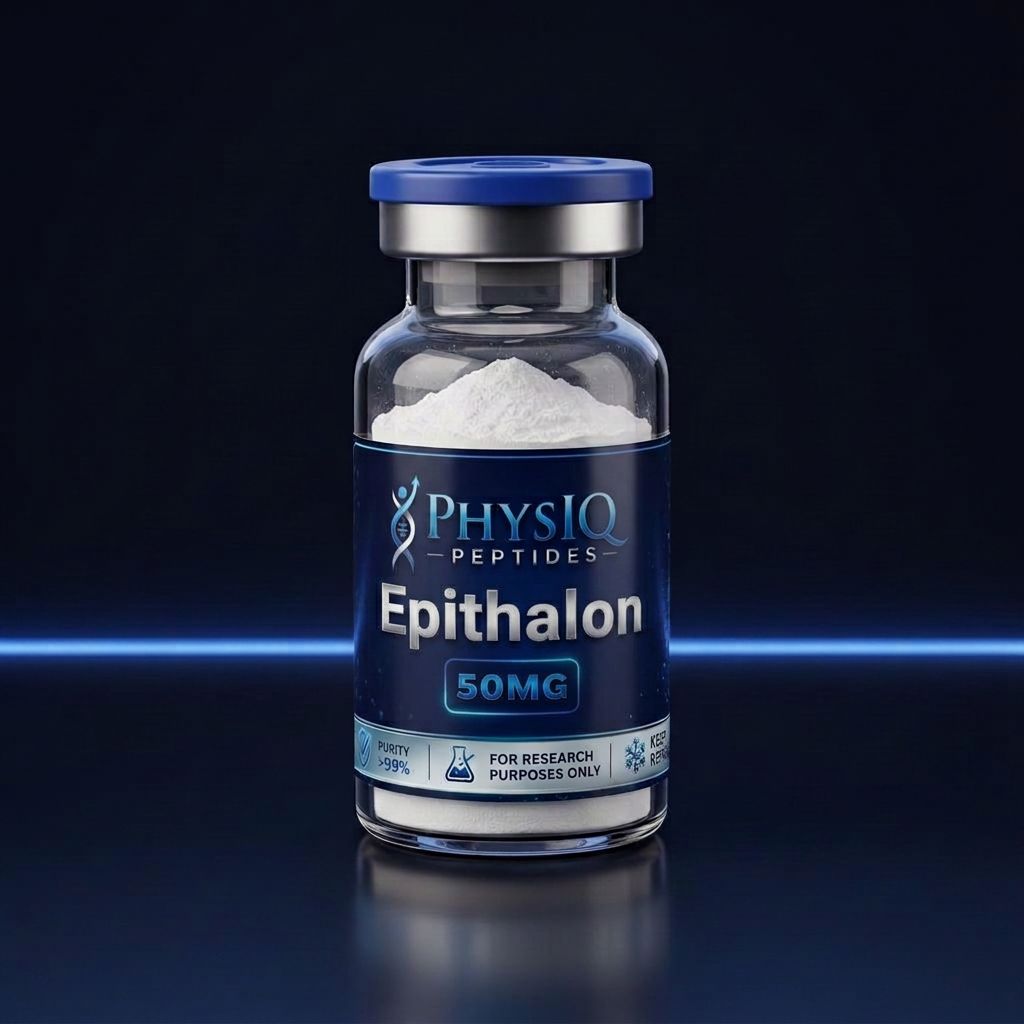
PhysIQ Peptides supplies epithalon as a lyophilized powder, third-party tested for purity and identity, for in vitro and laboratory research use only.
Choose how to buy
You save $3.75 every reship · ≈ $45.63 saved per year
Auto-delivered • Skip or cancel anytime • Never run out
Your first order ships at the regular price. Every reship after that is 5% off. Pause, change the interval, or cancel anytime.
- Purity
- 99%
- Form
- Powder (lyophilized)
- CAS Number
- 307297-39-8
- Molecular Formula
- C14H22N4O9
- Molecular Weight
- 390.35 g/mol
- Available sizes
- 50mg
Sequence
Ala-Glu-Asp-Gly (AEDG)
Mechanism of Action
The mechanism of epithalon is not fully established. Published cell-culture studies report induction of telomerase catalytic subunit (hTERT) expression and telomere elongation in somatic cells. Other studies propose that short peptides like AEDG can interact directly with DNA or chromatin to influence gene expression, and animal work has examined effects on pineal melatonin synthesis.
Research Areas
- ●Telomerase and telomere-length models
- ●Cellular senescence and replicative limit studies
- ●Pineal gland and melatonin rhythm research
- ●Short-peptide gene regulation
Selected References
- Khavinson VKh, et al. Bull Exp Biol Med. 2003;135(6):590-592.
Related Products