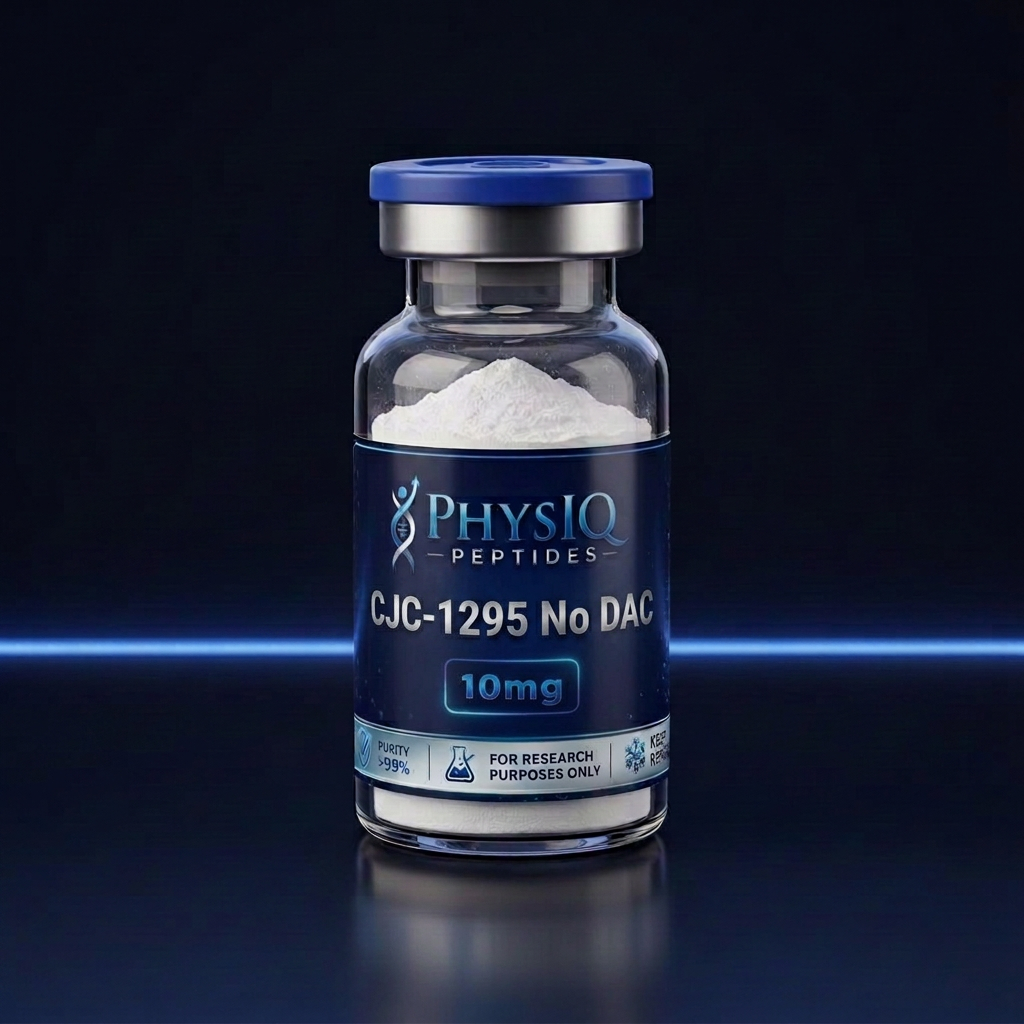
CJC-1295 No DAC
Modified Growth Hormone-Releasing Factor (1-29) (CJC-1295 without DAC)
CJC-1295 No DAC, commonly classified as Modified GRF (1-29) or tetrasubstituted GHRH (1-29), is a synthetic peptide analog representing the biologically active truncated core of endogenous growth hormone-releasing hormone. The sequence incorporates four strategic amino acid substitutions (D-Ala2, Gln8, Ala15, and Leu27) engineered to enhance resistance to dipeptidyl peptidase-4 (DPP-4) cleavage and prevent oxidative degradation while maintaining full receptor binding capability. Unlike DAC-conjugated variants designed for continuous albumin binding, CJC-1295 No DAC does not include the maleimidopropionic acid linker. Consequently, it maintains a shorter, physiological half-life in laboratory models, allowing researchers to study natural pulsatile growth hormone and downstream IGF-1 dynamics without disrupting baseline pituitary regulatory feedback mechanisms. In preclinical research settings, CJC-1295 No DAC is utilized to evaluate endocrine signaling, cellular proliferation, protein synthesis pathways, and metabolic kinetics, providing a controlled model for studying the mammalian somatotropic axis.
Choose how to buy
Subscribe & save 5% on reshipsYour first order ships at the regular price. Every reship after that is 5% off. Pause, change the interval, or cancel anytime.
- Purity
- ≥99%
- Form
- Lyophilized powder
- CAS Number
- 863288-34-0
- Molecular Formula
- C152H252N44O42
- Molecular Weight
- 3367.97 g/mol
- Available sizes
- 10mg
Sequence
Tyr-D-Ala-Asp-Ala-Ile-Phe-Thr-Gln-Ser-Tyr-Arg-Lys-Val-Leu-Ala-Gln-Leu-Ser-Ala-Arg-Lys-Leu-Leu-Gln-Asp-Ile-Leu-Ser-Arg-NH2
Mechanism of Action
CJC-1295 No DAC functions as a selective agonist at the growth hormone-releasing hormone receptor (GHRHR) located on the plasma membrane of anterior pituitary somatotrophs. Ligand-receptor binding stimulates the Gs alpha subunit, activating adenylyl cyclase and driving an intracellular accumulation of cyclic adenosine monophosphate (cAMP). This cascades into protein kinase A (PKA) activation, opening voltage-dependent calcium channels to trigger the episodic exocytosis of endogenous growth hormone. Due to its lack of a sustained covalent conjugate, the peptide clears within a physiological window, preserving endogenous somatostatin-mediated negative feedback loops and facilitating discrete, pulsatile secretory episodes rather than uninhibited continuous secretion.
Research Areas
- ●Pulsatile growth hormone signaling
- ●Pituitary somatotroph receptor kinetics
- ●Metabolic regulation and lipid oxidation
- ●Cellular proliferation and tissue repair
- ●Somatotropic feedback mechanisms
Selected References
- Teichman SL et al., J Clin Endocrinol Metab, 2006
- Alba M et al., Am J Physiol Endocrinol Metab, 2006
- Sackmann-Sala L et al., Growth Horm IGF Res, 2009
Related Products